Project “I” is a performative culmination of an artistic research project by ZM and Helene presumably* done in collaboration with AI as a sequal to performance, “Feed the Data”. Picture IDs of a specificly anticipated audience were discreetly obtained from social media and other public online platforms. A hidden spy camera was strategically installed within the exhibition space to capture the audience’s faces in real-time. Using deep fake live software, the captured facial data was seamlessly blended with the likeness of ZM, one of the project’s initiators, creating a hybrid identity that merged the audience’s features with hers.
This live, interactive element aimed to explore and critique the intersection of identity, privacy, and the uncanny in the digital age. By transposing the audience’s facial features onto (ZM’s) image, the project underscored the capabilities of contemporary AI while prompting critical reflection on issues of consent, surveillance, and the fluidity of personal identity in a digitized world.
The audience was informed that all data and images would be deleted after the performance. However, this raised a broader question: What does “deletion” truly mean in the digital sphere?
Ultimately, the project sought to challenge perceptions of self and other in the context of advanced digital technologies. By confronting the audience with their hybridized identities, the installation poses to rethink agency, performance, and interactions with digital tools and public spaces that host such technologies.
* speculative gaze/wishful thinking/enforced position ??
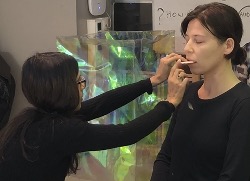
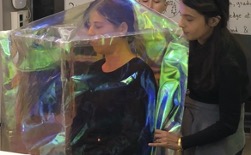
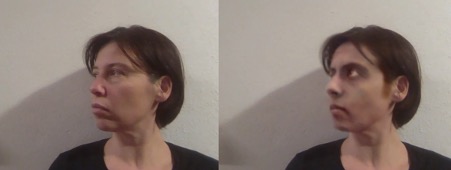
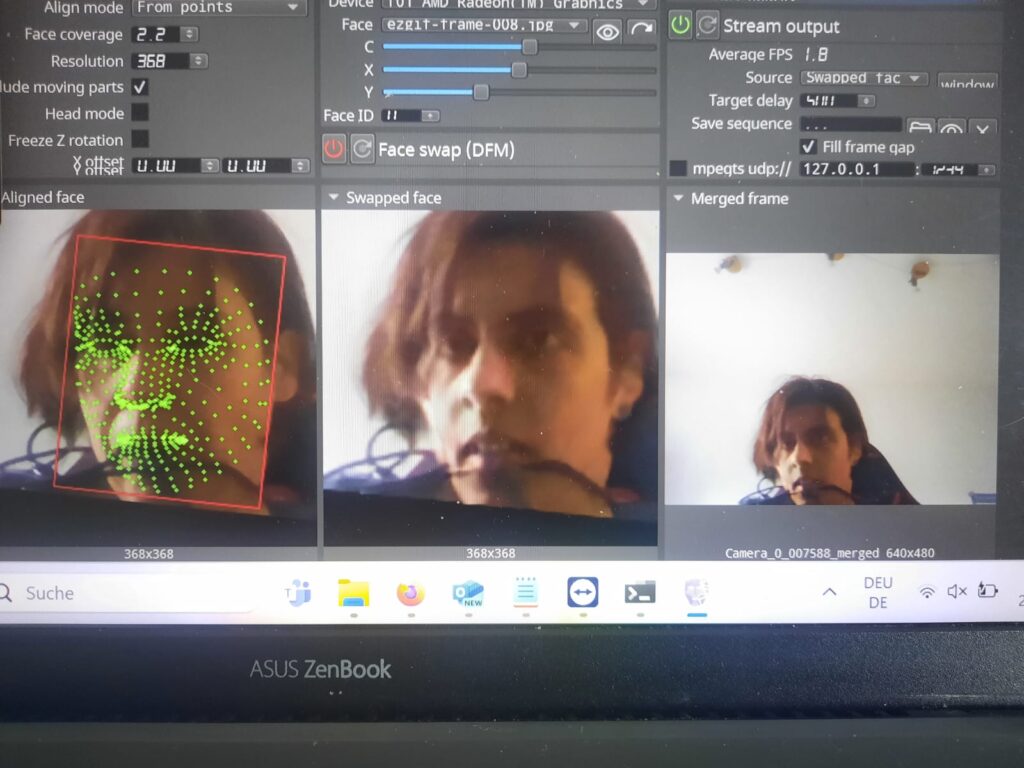
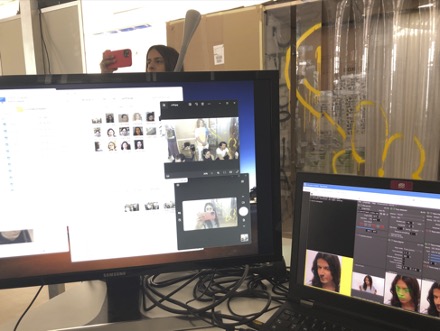
Research paper and resources available on request.
References:
Al-Badri, Nora, and Nikolai Nelles. The Influencers. Accessed February 20, 2024. https://theinfluencers.org/en/nora-al-badri-nikolai-nelles.
Artbreeder. Accessed October 29, 2023. https://www.artbreeder.com/.
Bishop, C. (2012). Artificial Hells: Participatory Art and the Politics of Spectatorship.
Borgdorff, H. (2012). The Conflict of the Faculties: Perspectives on Artistic Research and Academia.
Braidotti, Rosi. (2013). The Posthuman. Cambridge: Polity Press.
Brooks, R. A. (1991). Intelligence Without Representation.
CCCB (Centre de Cultura Contemporània de Barcelona). Maria Choir. Accessed January 22, 2024. https://www.cccb.org/en/activities/file/maria-choir/243188.
DeepFaceLab. Accessed November 10, 2023. https://github.com/iperov/DeepFaceLab.
Diakopoulos, Nicholas. (2016). Automating the News: How Algorithms Are Rewriting the Media. Harvard University Press.
Floridi, Luciano. (2016). The Ethics of Information. Oxford University Press.
Freud, Sigmund. (1899). The Interpretation of Dreams. Basic Books.
Freud, Sigmund. (1923). The Ego and the Id. Hogarth Press.
Goodman, Steve. (2015, November 16). Kode9: ‘I was pretty brazen about how I put things together’. The Guardian. Retrieved from https://www.theguardian.com/music/2015/nov/16/kode9-nothing-album-steve-goodman-hyperdub-interview (Accessed November 29, 2023).
Grosser, Ben. Our Emulated Multi-Self. Accessed November 10, 2023. https://bengrosser.com/projects/our-emulated-multi-self/.
Hansen, M. B. N. (2006). Bodies in Code: Interfaces with Digital Media.
Haraway, Donna. (1991). “A Cyborg Manifesto: Science, Technology, and Socialist-Feminism in the Late Twentieth Century.” In Simians, Cyborgs, and Women: The Reinvention of Nature. Routledge.
Hayles, N. K. (1999). How We Became Posthuman: Virtual Bodies in Cybernetics, Literature, and Informatics.
Heidegger, Martin. (1954). The Question Concerning Technology and Other Essays. Harper & Row.
Hour One. Accessed January 14, 2024. https://www.hourone.com/.
Ihde, D. (1990). Technology and the Lifeworld: From Garden to Earth.
Klingemann, Mario. Artist talk at Ars Electronica. Kepler’s Gardens. Accessed March 14, 2024. https://ars.electronica.art/keplersgardens/de/artist-talk-mario-klingemann/.
Kwon, M. (2004). One Place After Another: Site-Specific Art and Locational Identity.
Lacan, Jacques. (1953). The Function and Field of Speech and Language in Psychoanalysis. Éditions du Seuil.
Metaphysic AI. Accessed February 12, 2024. https://metaphysic.ai/.
Mitchell, W. J. T. (1994). Picture Theory: Essays on Verbal and Visual Representation.
OpenAI. (2023, December 4). Interaction with ChatGPT. [Posthuman materialism, digital avatar training, AI, Freudian Robotics and Artistic Research].
Paul, C. (2003). Digital Art.
Posters, Bill. Big Dada. Accessed February 29, 2024. https://billposters.ch/projects/big-dada/.
Reallusion. Accessed December 14, 2023. https://www.reallusion.com/character-creator/.
Russell, Stuart J., and Peter Norvig. (2009). Artificial Intelligence: A Modern Approach. Prentice Hall.
Schadler, C. (2015). Posthumanismus: Rosi Braidotti über Leben jenseits des Menschen. Soziopolis: Gesellschaft. Retrieved from https://nbn-resolving.org/urn:nbn:de:0168-ssoar-82586-7.
Soul Machines. Accessed November 14, 2023. https://www.soulmachines.com/.
SSENSE. “I Am Not an Authority on Who I Am.” SSENSE Editorial. Accessed February 29, 2024. https://www.ssense.com/en-us/editorial/art/i-am-not-an-authority-on-who-i-am.
Synthesia. Accessed November 14, 2023. https://www.synthesia.io/.
Taddeo, Mariarosaria, and Luciano Floridi. (2018). How AI can be a Force for Good. Oxford University Press.
Turkle, Sherry. (1995). Life on the Screen: Identity in the Age of the Internet. New York: Simon & Schuster.
Turkle, Sherry. (2011). Alone Together: Why We Expect More from Technology and Less from Each Other. Basic Books.
Winner, L. (1980). Do Artifacts Have Politics?